what happens to the volume of a gas when it is heated
Gas Laws
The content that follows is the substance of lecture 18. In this lecture nosotros cover the Gas Laws: Charles',Boyle's,Avagadro's and Gay Lussacs likewise as the Ideal and Combined Gas Laws.
Laws of Gas Properties
There are four general laws that relate the 4 basic feature backdrop of gases to each other. Each constabulary is titled by its discoverer. While it is important to understand the relationships covered past each law, knowing the originator is not as important and will be rendered redundant in one case the combined gas constabulary is introduced. Then concentrate on agreement the relationships rather than memorizing the names.
Charles' Law- gives the relationship between book and temperature if the force per unit area and the amount of gas are held constant:
one) If the Kelvin temperature of a gas is increased, the volume of the gas increases. (P, north Constant)
2) If the Kelvin temperature of a gas is decreased, the volume of the gas decreases. (P, northward Abiding)
This ways that the volume of a gas is straight proportional to its Kelvin temperature. Think of it this way, if you lot increment the volume of a gas and must go on the pressure constant the only mode to accomplish this is for the temperature of the gas to increment as well.

Calculations using Charles' Police force involve the change in either temperature (T2) or volume (V2) from a known starting amount of each (Vone and Tone):

Boyle'south Law - states that the volume of a given amount of gas held at constant temperature varies inversely with the applied pressure level when the temperature and mass are constant.

The reduction in the volume of the gas means that the molecules are striking the walls more often increasing the force per unit area, and conversely if the book increases the distance the molecules must travel to strike the walls increases and they hit the walls less often thus decreasing the pressure.
Like Charles' Law, Boyle's Law can be used to determine the current pressure or volume of a gas so long equally the initial states and one of the changes is known:

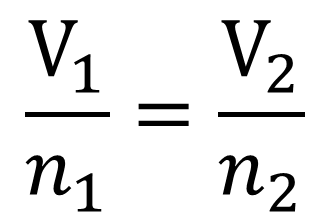
Avagadro'due south Constabulary- Gives the relationship betwixt volume and amount of gas in moles when pressure and temperature are held constant.
If the amount of gas in a container is increased, the volume increases. If the amount of gas in a container is decreased, the volume decreases. This is assuming of grade that the container has expandible walls.
The relationship is over again directly proportional so the equation for calculations is
Gay Lussac'south Constabulary - states that the pressure of a given amount of gas held at abiding volume is directly proportional to the Kelvin temperature.

If you heat a gas you give the molecules more energy then they movement faster. This means more impacts on the walls of the container and an increment in the force per unit area. Conversely if you cool the molecules down they will boring and the pressure will be decreased.
To calculate a change in pressure or temperature using Gay Lussac's Law the equation looks similar this:

To play effectually a bit with the relationships, try this simulation.
The Platonic Gas Law:
A combination of the laws presented above generates the Ideal Gas Law:
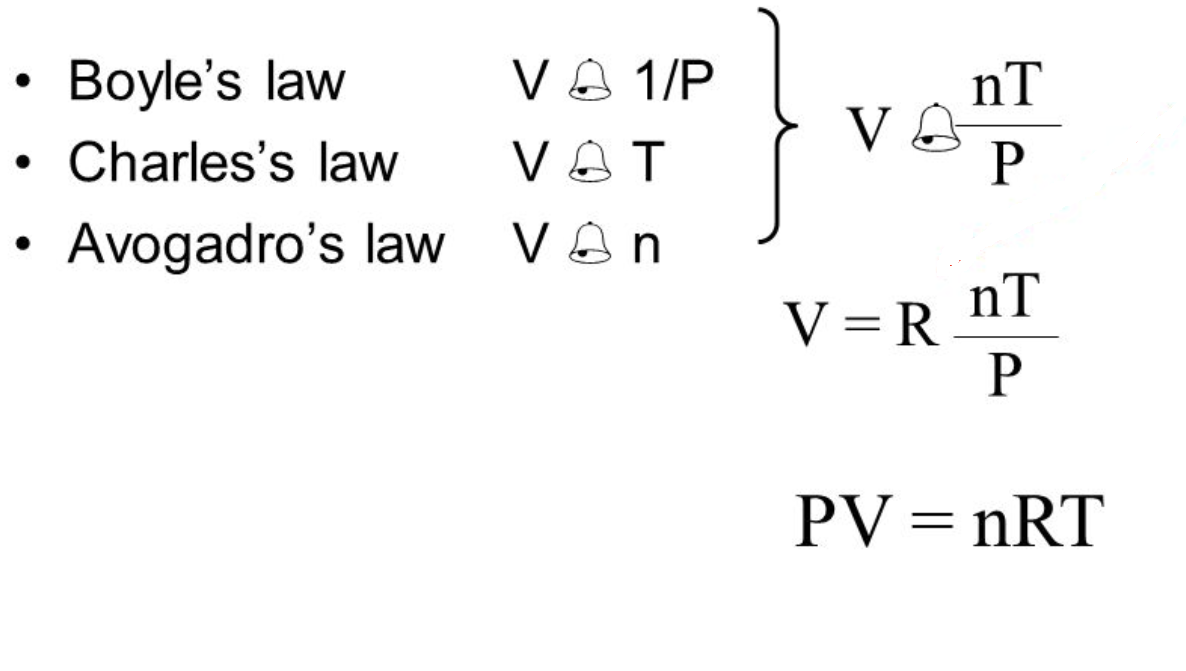
The addition of a proportionality abiding called the Ideal or Universal Gas Constant (R) completes the equation.
Every bit yous can see there are a multitude of units possible for the constant. The only abiding well-nigh the abiding is that the temperature scale in all is KELVIN.
When using the Ideal Gas Law to calculate whatever property of a gas, you must match the units to the gas constant you lot choose to use and you always must place your temperature into Kelvin.
To utilise the equation, you only need to be able to identify what is missing from the question and rearrange the equation to solve for it.
A typical question would be given as 6.2 liters of an platonic gas are contained at 3.0 atm and 37 °C. How many of this moles of the gas are present?
Because the units of the gas abiding are given using atmospheres, moles, and Kelvin, information technology's important to brand sure y'all catechumen values given in other temperature or force per unit area scales. For this problem, catechumen °C temperature to K using the equation:
T = °C + 273
T = 37 °C + 273
T = 310 K
At present, you can plug in the values. Solve for the number of moles
due north = PV / RT
n = ( three.0 atm ten 6.2 Fifty ) / ( 0.08206 L atm /mol K x 310 Thou)
n = 0.75 mol
Here are some practice problems using the Ideal Gas Law: Practice
The Combined Gas Law
I said higher up that memorizing all of the equations for each of the private gas laws would get irrelevant afterwards the introduction of the laws that followed. The law I was referring to is the Combined Gas Law:

The combined gas law allows yous to derive any of the relationships needed past combining all of the changeable peices in the platonic gas law: namely pressure, temperature and volume. R and the number of moles do not announced in the equation as they are generally constant and therefore abolish since they appear in equal amounts on both sides of the equation.

As you can come across above, the equation can be solved for any of the parameters in it. But more than chiefly, you lot can eliminate from the equation annihilation that will remain constant.
For Example, If a question said that a system at 1atm and a volume of 2 liters, underwent a change to three.5 liters, calculate the new pressure, you could but eliminate temperature from the equation and yield:
P2 = PoneV1/Vii = (1atm)(2L)/3.5L) = 0.6 atm
Since the question never mentions a temperature we can presume information technology remains a constant and will therefore cancel in the calculation. Yous should likewise recall about the answer y'all go far terms of what you know almost the gases and how they act. We increased the volume so the pressure should go downward. Checking our reply, this appears to be correct since the force per unit area went from 1atm to 0.6atm.
So the only equation you lot really demand to know is the combined gas constabulary in club to summate changes in a gas' backdrop.
Hither are some practice issues with solutions: Exercise
Here are some problems for the other gas laws that y'all can derive from the combined gas police: Practice and KEY
Source: https://www.chem.fsu.edu/chemlab/chm1045/gas_laws.html
0 Response to "what happens to the volume of a gas when it is heated"
Post a Comment