How to Edit a Tomodachi Life Save File to Make a Baby Instantly
|
|
 | A |
Tomodachi Drove [ Edit ] [ Talk ]
| Tomodachi Collection | |
|---|---|
 | |
| Developer | Nintendo SPD1 |
| Publisher | Nintendo |
| Platforms | Nintendo DS |
| Release appointment |  June 18, 2009 June 18, 2009 |
| Genre | Life simulation |
| Ratings | CERO- A |
| Website | Official Site (JP) |
Tomodachi Drove (トモダチコレクション , Tomodachi Korekushon ? , lit. "Friend Collection") is a life simulation game for the Nintendo DS released on June 18th, 2009, exclusively in Nihon. It is the commencement game in the Tomodachi series. A sequel named Tomodachi Life was released in Nihon on April 18th 2013, and in America and Europe on June 6th, 2014.
Gameplay
The game takes identify on an island in the middle of the sea, that can be populated with various Miis created from the built in Mii Maker, or transferred wirelessly from a Wii console. These Miis can be given a personal voice and personality based on the histrion'southward liking. Once each Mii is made, they volition move into their own apartment on the isle, allowing them to explore the island and its various facilities. As more Miis are added, more than facilities and activities are unlocked, and the Miis may even go friends with 1 some other, hanging out in their flat or outside.
Miis themselves can also exist interacted with in their apartment, allowing the player to give them food, wearing apparel, or an interior for their apartment. Depending on how much they like it, the Mii's happiness will get upwards, and once it reaches a certain bespeak, the Mii volition level up, allowing the player to give them a level-up gift, such every bit a phrase or a song as a reward. If the Mii is comatose, the player may have a chance to view a dream, leading to a bizarre mini-game, outcome, or activity.
At certain times, events can be held that the player can witness, exist it Street Alive at the fountain, or Question at the Question Hall.
Differences in Tomodachi Drove
Compared to the later-released Tomodachi Collection: New Life/Tomodachi Life, Tomodachi Collection has several unlike gameplay mechanics.
- Tomodachi Collection runs at 60 frames-per-second, while Tomodachi Life runs at thirty frames-per-second.
- The main island is much smaller, consisting of only Mii Apartments, the Town Hall (chosen City Hall), the Clothing Shop (called Apparel Shop), the Pawn Shop, the Food Mart, Interiors, the Fountain,the Rankings Board, the Compatibility Tester, Mii News, and two buildings non present in Tomodachi Collection: New Life: Question Hall and Task Diagnosis.
- Quirky Questions and Judgement Bay are hosted inside the fore-mentioned Question Hall.
- The Fountain is the just location in the game to hold scheduled events. An "Result" balloon is not shown hovering to a higher place it when an result is being held. It also hosts Street Live and English Lesson, which are not present in Life.
- There is no Office in the Mii Apartments. Island info is instead displayed on a billboard exterior the apartments. Apartments as well cannot be swapped.
- The Personality chart is accessible in the Town Hall.
- The Town Hall'due south options are different:
- Ship/Receive works differently, allowing users to import Miis direct from a Wii arrangement (because the DS lacks a built-in Mii creator).
- QR Codes are unavailable because they were non introduced by then.
- A save button is not bachelor on the bottom of the touch screen, although the Offset button can even so be used to quick-Save.
- On the Rankings Board, the island, traveler, and splurge rankings are unavailable.
- The Romance Ranking displays the 20% parings or lower with both Miis aroused instead of sad.
- On the island, the day to night transition is much more fluid than depicted in Life.
- Miis tin can be given one of four blood types.
- This, withal, is even so present in the Japanese version of Life.
- In that location are no "Locate" and "Telephone call" options for when a Mii is not at dwelling house.
- Miis only have one all-time favorite dish and one worst dish instead of two, lacking the "Super" favorites.
- The animations Miis brand when they eat their favorite/worst favorite are different.
- Hats and hair dye are not available.
- If the item intended to be given to a Mii is launched loftier in the room and falls behind them, it becomes horrified in shock for a few seconds earlier turning his/her caput back towards the tossed particular and walking over to pick it up. In Tomodachi Drove: New Life, they turn their caput towards the thrown item almost immediately.
- Songs are performed direct within the Mii's apartment, rather than inside the Concert Hall.
- Singing Miis also cannot be put into groups.
- Players cannot freely edit song lyrics with the keyboard, but being able to utilize pre-fabricated words and phrases instead.
- The option of bonuses a Mii tin can get upon level-up differs:
- The available songs are unlike, offer vi styles rather of 8.
- The option of gifts a Mii can be given are dissimilar, featuring the post-obit:
- Duster
- Laptop
- Study kit
- Novel
- Cell telephone (resembles a classic folding cellphone instead of a smartphone)
- CD (every bit a headset rather than a radio placed on the flooring)
- Wii (replaced with the Wii U in Tomodachi Collection: New Life)
- DS (replaced with the 3DS XL in Tomodachi Drove: New Life)
- Gifts given to a Mii tin can take different colors, which match the Mii's favorite color. Since in that location are exactly viii gifts, Miis can accept all 8 at once.
- The offered interiors available through level-upwardly also differs:
- Country
- Industrial
- Family
- Natural woods
- Scandinavian
- European
- Miis cannot be given pocket money, therefore Miis cannot go on trips to space. In one case the Mii reaches the Level 22, the player tin no longer give them gifts as they accept everything.
- The playable Islander Mini-Games differ slightly betwixt Drove and Life, including a few that practice not return in Life.
- Likewise, the pseudo-games consist of mosquito and backscratching, the former which was moved to an activity in the Campgrounds, while the latter was removed entirely and replaced with sneezing.
- When Miis go to sleep for the night, their beds are colored the same equally their depicted favorite colour. In Life, all of the apartment beds are identical, differing only in size.
- Dreams volition only produce items if the Mii has the dream while sleeping in bed for the night. Dreams that occur through a napping Mii will not produce any items.
- Collection has a different selection of dreams than what is featured in Life.
- Clothing with more than 1 color has each color variant represented every bit a dissever piece of wear with their own slot in the listing instead of all colors of one article of clothing sharing the same slot and cycled through with 50 and R. Article of clothing with more than one color are read as "Wearable proper noun (Color)".
- In the wearable shop, items given out through special occurrences (such as dreams) are not added to the shop's list, and they must exist re-acquired through the special event.
- Wedlock is performed much differently than in Life, with two sweethearts instantly marrying. In subsequently installments, there is a minigame where the player has to aid one of them propose.
- Married couples do non get their own living space, as Mii Homes does non exist.
- Babies are unavailable in Collection. Thus, the game's end credits are shown during a matrimony, rather than after a child has fully grown.
- StreetPass and SpotPass items are not present in Collection as neither of those two functions have existed.
- The background music in Collection (released in the December 2011 album Tomodachi Collection Platinum Soundtrack) is mostly different from the music in Life. But a few tracks are shared between the games, such equally "City Hall" and "Save Screen".
- Miis tin can develop feelings for those who are already married, but will ever get rejected. This is changed in Japanese version of Tomodachi Life, where the Mii would either become accepted or rejected. In Western version of Tomodachi Life, nobody will fall in honey with the married Mii, unless the married Miis become single once again with the breakup.
- Confessions take four locations (only the embankment, park, school (classroom), and rooftop), and the manners are as well four (but traditional, romantic, arrogant (Showy), and desperate). There are no interventions.
- Miis can only have normal fights. Huge fights are not available.
- In addition, if the amends is rejected, the other Mii will not say they are sick of fighting and want to reconcile. They also will never exist friends again.
- The Miis can simply take artistic photos with the photographic camera.
- Miis will non ask to accept a look effectually their apartment after being given a new interior.
- If a Mii has a friendship trouble, their window will use the greyness dust deject icon, instead of the orange smiley confront icon. Sadness problems are purple instead of blue.
- When Miis want to make friends, the person they want to befriend will visit the request Mii's apartment, instead of the asking Mii going to the other Mii's apartment. Miis cannot introduce two to each other.
- The vocal's primal changes depending to the pitch and the gender: if a Mii has a female high voice it shift it upwardly ii and half tones.
- Miis say "Thank yous" if the player gives them nutrient, and wipe their mouth with i manus. This information technology too shown in the Japanese version of Life.
Locations
| Location | Epitome | Information |
|---|---|---|
| Island | 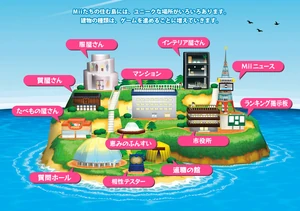 | The master hub earth in the game, where every other location tin be establish. |
| Mii Apartments | 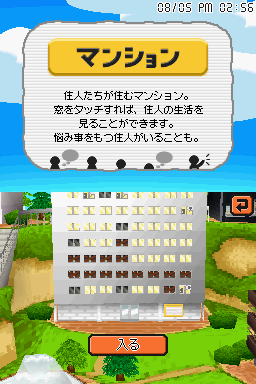 | Mii Apartments is the apartment building where the player'southward Miis reside. By tapping on various windows, the player can interact with their Miis. |
| Food Mart | 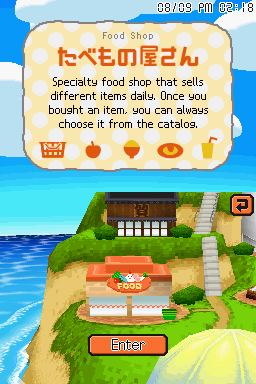 | The Food Mart is one of four shops featured on the island, after the Clothing Shop, the Interiors Shop, and the Pawn Store. The Food Mart is where the player can buy various food items to give to their islanders, which updates daily. |
| Wearing apparel Shop | 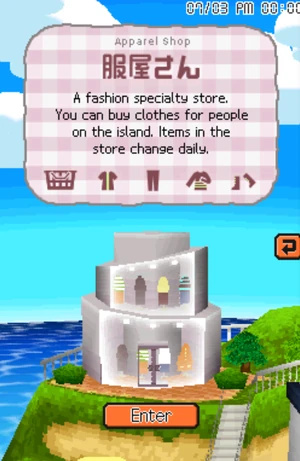 | The Wearing apparel Shop is another shop featured on the island, serving every bit an area where the player can buy clothing for their islander. |
| Interiors Shop | 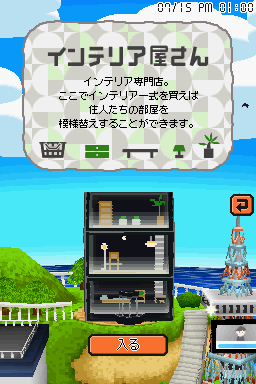 | The Interiors Shop sells interiors to the player, updating every day. The shop is also known to have special interiors every month, besides every bit other interiors that are unlocked when a Mii reaches a certain level on the Island. |
| Pawn Store |  | The Pawn Shop is an area where the thespian can sell treasures that they no longer desire. |
| Fountain | 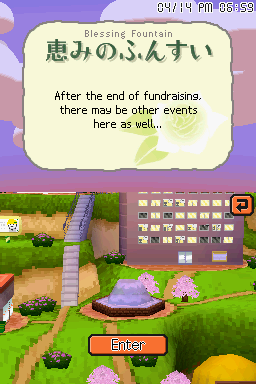 | The fountain is an surface area that exists in the island plaza, serving its purpose as a public hangout place where Mii can talk or exercise. The events include donations, English Lesson, Street Alive, and Morning Market. |
| Question Hall | 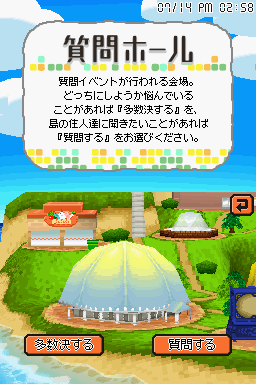 | The Question Hall is an area that can used to asked Miis quirky questions, or have them vote based on ii choices. Either of these can exist initiated at any time. |
| Job Diagnosis | 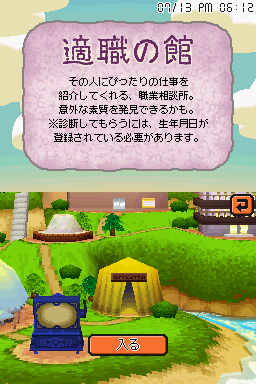 | The Job Diagnosis is where Miis can be given jobs without the employ of a job ticket, such as a dancer, talk show host, or fireworks crafter. This can simply be washed with Miis that have registered birthdays, notwithstanding, as a Mii without a birthday cannot be given a job. |
| Mii News | 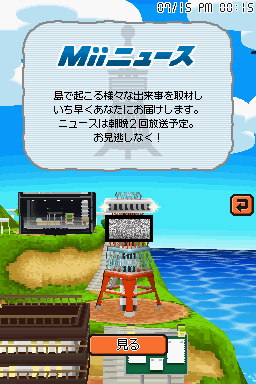 | Mii News is a news station that broadcasts news at vii:00 AM to 7:00 PM, which range from humorous reports to numerous events that have taken place on the island, such as when a new building opens. Two random Miis tin can also be seen being interviewed afterward the written report is finished, maxim a comment to the news team. |
| Rankings Lath | 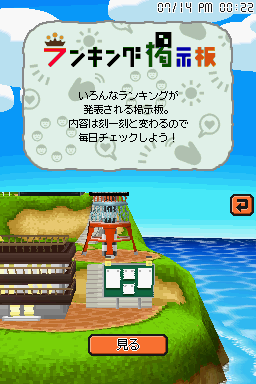 | The Rankings Board is an area that postal service rankings based on several factors exhibited by the islanders, such as vitality, level of amuse, or level of popularity. |
| Compatibility Tester | 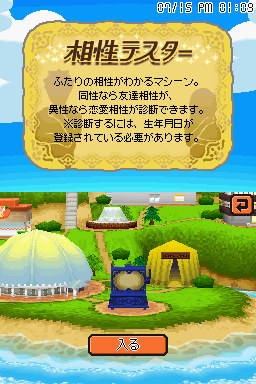 | The Compatibility Tester is a location that analyzes two islanders to decide their level of chemistry. Depending on age and genders used, this can range from a romance rating to a friend rating. |
| Metropolis Hall | 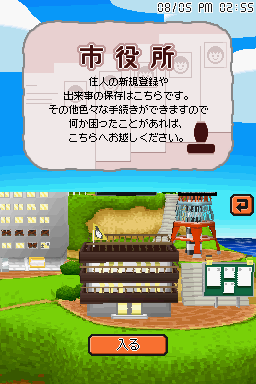 | The Metropolis Hall is where the histrion can gather all the data of the island, including its residents, their personalities, and the time on the isle. |
Development
The game was adult past Nintendo'south SPD group, being directed past Ryutaru Takahashi and produced by video game designer Yoshio Sakamoto, the latter of which is best known for his piece of work in the Metroid franchise also made by Nintendo. The team was mostly fabricated up of younger developers in a pocket-size environment. Early on in development, the game was going to be called "Fortune Telling Notebook for Adult Women" and would only feature only adult female characters. The game was later on reworked to have more focus on life simulation, and thus Tomodachi Drove was made. [citation needed]
Although a Western localization was planned, Information technology was not finalized, due to the DS being unable to translate the phonation synth into English. Despite this, a 2013 fan translation past jjjewel exist.
Reception
In Nihon, the game has received generally positive reviews. Famitsu gave the game a 29 out of 40. On the twenty-four hour period of its release, the game sold over 102,000 units, making it the best-selling DS game in that catamenia. On March tertiary, 2010, Nintendo announced the game had sold 3.ii 1000000 copies in total.
Gallery
- Master Commodity: Tomodachi Collection/Gallery
Tomodachi Collection has a ton of photos merely nothing compared to Tomodachi Life.
Videos
- Main Article: Tomodachi Collection/Videos
Similar thing with the videos, everything is smaller in Tomodachi Collection.
| Tomodachi series | ||||
|---|---|---|---|---|
| ||||
Source: https://tomodachi.fandom.com/wiki/Tomodachi_Collection
0 Response to "How to Edit a Tomodachi Life Save File to Make a Baby Instantly"
Post a Comment